The Secrets of Chimneys: Why Do Some Older UK Chimneys Have No Caps?

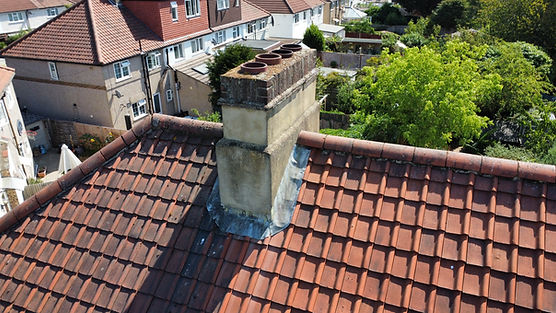
When inspecting roofs using a drone, I often come across rows of traditional chimney pots, particularly on older British properties.
Some have cowls or rain caps fitted, while others are completely open at the top.
This often raises a question from homeowners and buyers:
“If there is no cap, doesn’t rainwater simply fall straight down the chimney?”
The answer is yes. Rainwater can enter an open chimney flue.
However, an uncapped chimney does not necessarily mean that rainwater is causing dampness inside the property.
To understand why, we need to look at how traditional chimneys were designed and how their use has changed over time.
Understanding Traditional Chimney Construction
A chimney stack on an older British property may contain several separate flues, each serving a fireplace in a different room or on a different floor.
These flues are not always completely vertical. Some incorporate offsets to connect fireplaces to the chimney pots above.
Historically, when fireplaces were regularly used, hot combustion gases travelled upwards through the flues, creating a natural draught.
The heat generated during use also helped evaporate some moisture within the chimney.
However, many fireplaces in older properties are no longer used, and some have been permanently closed off.
This is where problems can arise.
When Sealing a Chimney Creates Another Problem
It is understandable that homeowners may want to prevent rainwater from entering an unused chimney.
Sometimes, the immediate solution is to seal the chimney pot completely or block the former fireplace opening.
However, sealing a disused chimney without providing adequate ventilation can create further moisture problems.
Without the heat previously generated by the fireplace, the flue may remain relatively cold. If ventilation is restricted, moisture within the chimney can become more difficult to disperse, potentially contributing to condensation and dampness.
There is another issue that is often overlooked.
Older chimney flues may contain residues from years of burning coal or other fuels. These can leave behind hygroscopic salts, which absorb moisture from the surrounding air.
As a result, damp patches, staining or deterioration of plaster and decorative finishes may appear on the chimney breast, even where there is no evidence of an active rainwater leak.
This is why dampness around a chimney breast should not automatically be attributed to an uncapped chimney pot.
What Should Be Considered During a Building Survey?
When assessing a chimney, the absence of a cap is only one of several considerations.
Other visible elements may include:
Flaunching: The mortar surrounding the chimney pots, which may deteriorate or crack over time.
Brickwork and mortar joints: Weathering and defective pointing can allow rainwater penetration.
Lead flashings: Defects at the junction between the chimney stack and roof covering may allow water ingress.
Internal dampness: The location and pattern of staining may provide useful evidence, although they do not establish the cause on their own.
Flue use and ventilation: Whether the chimney remains connected to a working appliance, has been taken out of use, or has been sealed without adequate ventilation.
Drone inspections can provide useful views of chimney stacks and other roof areas that are difficult to inspect from ground level.
However, photographs cannot establish the internal condition of a flue or confirm the cause of dampness within a property.
Further investigation may be necessary where defects or moisture-related concerns are identified.
Should an Unused Chimney Be Capped?
There is no single answer that applies to every property.
For a disused chimney, suitable weather protection may help reduce rainwater entering the flue. However, adequate ventilation should also be considered to avoid trapping moisture within the chimney structure.
Where a chimney remains connected to a working fireplace, stove or other combustion appliance, any cowl or terminal must be appropriate for the appliance and flue system.
An unsuitable terminal or an obstructed flue can interfere with the safe discharge of combustion products and potentially create a carbon monoxide hazard.
Any alterations affecting an active flue should therefore be assessed by a suitably competent professional.
Final Thoughts
An open chimney pot does not automatically indicate a defect, and fitting a cap is not necessarily the solution to dampness around a chimney breast.
In some cases, inappropriate sealing of a disused chimney may contribute to moisture-related problems rather than prevent them.
Traditional chimneys were designed to work with heat, airflow and ventilation. Understanding how these factors interact is important when assessing their condition, particularly in older properties where fireplaces have been altered or taken out of use.
A building survey is not simply about identifying what is visible. It is also about understanding how traditional construction works and recognising when further investigation is needed.
SurveyUs | The Secrets of Buildings
Building observations and insights into traditional British construction.


Comments